Dividing Humanity: Humans, Humanisms, Inhumans
To create, say the great founding texts, is to share and distinguish: between mortals and immortals, between humans and beasts, between an eternal God and ephemeral beings, between a perishable body and an immortal soul…
This first gesture launches the whole investigation. Its purpose is to examine the ways in which these divisions have been taken up, transformed, contested and rejected over the centuries. So many historical figures of man are examined, one chapter after another: The Greek anthrôpos, the Roman homo humanus, the homo christianus, then the man of the humanists, the one who makes his own the “I am man and nothing human is foreign to me”, before the proclamation “man is a God for man”, itself soon followed by the announcement of “the death of man”, leads to the rejection of a “proper” of man and of all the dualisms which, over the centuries, have marked his history.
Humans, humanisms, inhumans: the subtitle further defines the historical framework. By combining and opposing each other, the three terms form a system. Humanism, by seeking to distinguish the human from the inhuman, has sought ways for humans, or at least some of them, to be more or better human. This has not always prevented them from being blind to the inhuman. Today, in the face of the inhuman, humanitarianism claims to act in the name of a human characteristic: dignity.
To retrace the great arc that leads from the formation of anthrôpos to its dissolution implies neither that this path was mapped out in advance, nor that it must lead to some kind of apocalypse. On the contrary, it shows how the present moment of widespread disorientation is part of a long history. And, at the same time, to help us understand it better.
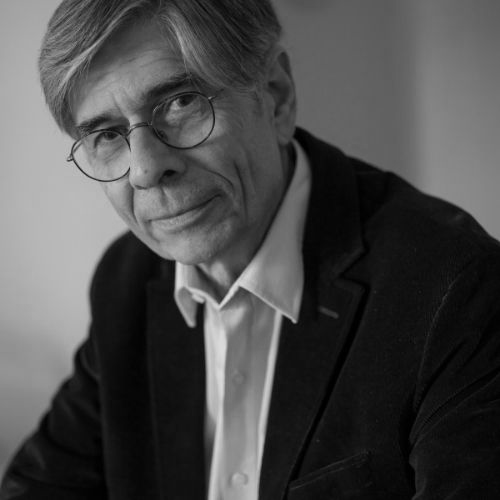
François Hartog is a French historian and Director of Research Emeritus at the École des Hautes Études en Sciences Sociales (EHESS) in Paris, where he has held the Chair of Modern and Antique Historiography. Born in 1946 and educated at the École Normale Supérieure, he was a student of Jean-Pierre Vernant and worked alongside Reinhart Koselleck. His early scholarship focused on ancient Greek historiography, most notably through his celebrated study of Herodotus. His later work introduced the influential concept of "regimes of historicity," which examines how different societies relate to past, present, and future. His book Regimes of Historicity: Presentism and Experiences of Time (Columbia University Press, 2015) has been translated into numerous languages and is considered essential reading in the philosophy of history. Hartog is widely regarded as one of the most significant theorists of historical time writing today.